
Mrs Gandhi's power ebbed and peaked with the times. Mr Modi's has almost been constant, barring the few months of hard dip after the 240 seats of 2024, points out Shekhar Gupta.

Prime Minister Narendra Modi criticized the RJD's past education policies in Bihar, attributing migration to the state's poor education system under their rule. He praised the current NDA government's efforts to improve education and development, launching several initiatives focused on youth skilling and education in the state.
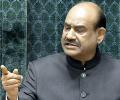
The opposition has submitted a notice for a resolution to remove Lok Sabha Speaker Om Birla, citing disallowed speeches and MP suspensions.
'Some success has been achieved in raising the costs of terrorism for Pakistan.'
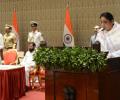
Sunetra Pawar, wife of late NCP leader Ajit Pawar, was sworn in as Maharashtra's first woman deputy Chief Minister after being elected as the leader of the NCP legislature wing.

8 Member of Parliaments were suspended from Lok Sabha for tearing & throwing papers at the Chair till April 2. Uproar started when Rahul Gandhi was barred from citing former Army Chief, General M M Naravane's memoir on 2020 India-China clash. Rediff.com brings you the details of these MPs who were suspended.
A lot of the 100-day programmes would be 'milestone-based' with timelines for achieving targets for social-sector schemes.

The Indian economy is likely to grow at 7.4 per cent in 2025-26, up from 6.5 per cent in the previous fiscal, mainly on account of better performance of manufacturing and services sectors, as per the government data released on Wednesday.

New Delhi will substantially reduce tariffs on industrial and agricultural goods while continuing to protect sensitive sectors. Tariffs on some agricultural products that are not traditionally considered sensitive will be brought down to zero, while in the case of relatively sensitive items, duties will be reduced in a graded manner and quotas will be imposed.
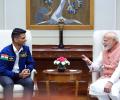
Shukla said the two missions presented a major opportunity for the country and the sustained commitment of the government to the space sector, despite setbacks such as the Chandrayaan-II mission was laudable.
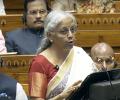
Here are some facts related to the Budget presentation in independent India.

This comes a day after President Droupadi Murmu gave her assent to the Viksit Bharat Guarantee for Rozgar and Ajeevika Mission (Gramin) (VB-G RAM G) Bill, which replaces the MGNREGA and has a provision for 125 days of wage employment for rural workers.
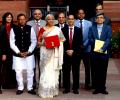
Finance Minister Nirmala Sitharaman on Saturday said the Union Budget 2025-26 continues efforts to accelerate growth and provide inclusive development.
Attacking the government for a provision of a mere Rs 500 (Rs 5 billion).

This has been our history of good governance: Things that were difficult to do and required planning and implementation were first taken up and then abandoned, notes Aaakr Patel.

Real GDP growth surprised on the upside in 2025, but weaker nominal growth, trade uncertainty, and soft demand signal a bumpier road ahead.

Finance Minister Nirmala Sitharaman on February 1 will present a record eighth consecutive budget that is expected to contain measures to shore up weakening economic growth and ease the burden on the middle class struggling with high prices and stagnant wage growth while being fiscally prudent.
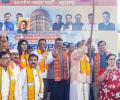
Breaking the nearly three-decade-old dominance of the undivided Shiv Sena, the Bharatiya Janata Party on Friday emerged victorious in the Brihanmumbai Municipal Corporation (BMC) elections, and also vanquished the alliance of Nationalist Congress Party factions led by Sharad Pawar and Ajit Pawar in the Pune civic body.

Congress leader Shashi Tharoor addresses concerns about his recent statements, asserting his alignment with the party's principles and goals.

The Maharashtra municipal elections showed a troubling shift, where votes were traded for cash, convictions no longer mattered, and ideology became an afterthought, observes Ramesh Menon.

As per established tradition, the finance minister met the President at the Rashtrapati Bhavan before heading to Parliament.

It will be the second Budget of the Modi 3.0 government and eighth straight Budget for Nirmala Sitharaman, rare in Indian polity.

The President will address both the Houses of Parliament assembled together in the Lok Sabha chamber on Friday and Finance Minister Nirmala Sitharaman will present the General Budget on Saturday.
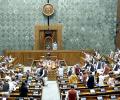
India's opposition parties have sharply criticized the Union Budget, calling it inadequate to address the country's economic woes and accusing the BJP-led government of using it to woo voters in Bihar and Delhi ahead of upcoming elections. Leaders from the Congress, TMC, DMK, SP, and CPI(M) voiced their disapproval, highlighting concerns over inflation, unemployment, and the lack of substantial measures to support the agricultural sector and the poor. They also criticized the tax cuts for the middle class as insufficient and coming too late after years of high taxes and rising prices.

Most of the extra spending in the Budget is in fact an accounting entry that shifts the cost of an interest subsidy to the agriculture Budget that was previously borne by the finance ministry

With the fiscal deficit target staring at the government, the FY25 Budget has limited expenditure options, points out A K Bhattacharya.
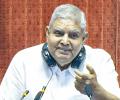
'Modi's charisma may have weakened as last year's Lok Sabha poll results showed but in the eyes of the Sangh Parivar, it has not waned.' 'Minus a strong BJP government at the Centre for another decade and more, there is apprehension that an anti-Hindutva government could reverse many of the ideological gains that the Modi dispensation has achieved through its three terms,' points out N Sathiya Moorthy.

Banking on the Budget's tax relief, the BJP seeks to energise Delhi's middle class; the AAP is doing its bit too. But will their outreach mobilise this politically crucial yet disengaged electorate?

This will be the first full-year Budget of the BJP-led National Democratic Alliance government since it came to power for a third consecutive term in July last year.

This will be the first budget presented by the government led by Prime Minister Narendra Modi in its third term amid high anticipation following President Droupadi Murmu's assertion that it will be marked by many historic steps.

President Droupadi Murmu has given her assent to the Viksit Bharat Guarantee for Rozgar and Ajeevika Mission (Gramin) Bill, which aims to replace MGNREGA and guarantee 125 days of wage employment per rural household.

Finance Minister Nirmala Sitharaman on Friday participated in a traditional 'halwa' ceremony, marking the final stage for the preparation of Union Budget 2025-26 to be unveiled on February 1 in the Lok Sabha. The ceremony is a customary ritual in which traditional dessert 'halwa' is prepared and served to officials and staff members of the finance ministry who are involved in the preparation of the Budget.
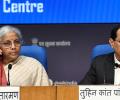
'Our attempt to honour the taxpayer has been since 2014 and more actively since 2019-2020 onwards.'
Prime Minister Narendra Modi's landslide election in 2014 raised hopes he would draw a line under India's socialist past, cut welfare and reduce the government's role in business.

Congress leader Priyanka Gandhi Vadra criticizes the government's proposed bill to replace MGNREGA, arguing it weakens the guaranteed 100 days of employment for the poor and centralizes control over the scheme.

Modi claimed the Congress, when in power at the Centre, had drawn up plans to allocate 15 percent of the total budget to minorities.
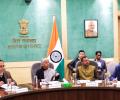
Parliament's Budget Session will be held from January 31 to April 4, with Finance Minister Nirmala Sitharaman set to table her eighth straight budget on February 1. The session will begin with President Droupadi Murmu's address to a joint sitting of the Lok Sabha and Rajya Sabha on January 31, followed by the tabling of the economic survey. The first part of the Budget Session will have nine sittings from January 31 to February 13, after which Parliament will break for recess to examine the budget proposals. The session will reconvene on March 10 to discuss the demands for grants of various ministries and complete the budgetary process, concluding on April 4.
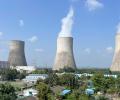
The Bill is likely to pave the way for amending two existing legislations -- the Atomic Energy Act 1962, and the Civil Liability for Nuclear Damage Act 2010.

Finance Minister Nirmala Sitharaman on Saturday announced the government's plan to transform India into a large logistics organisation with 1.5 lakh rural post offices.

'MGNREGA was about a guaranteed right to work.' 'The new law does not guarantee employment at all.' 'It removes everything that made MGNREGA a legal guarantee.'
